No products added!
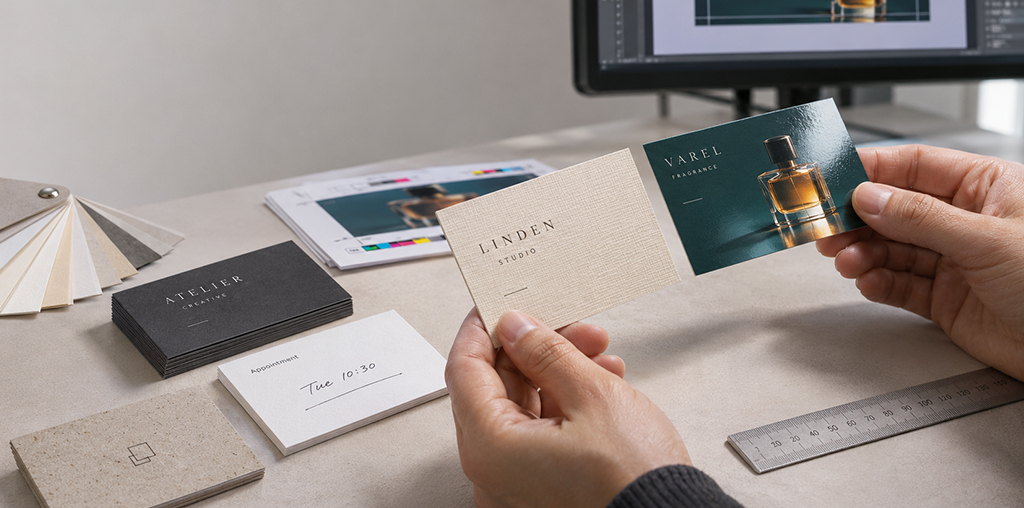
Custom Business Cards Printing Melbourne projects often start with a choice between matte, gloss, and uncoated cardstock. For example, matte cardstock reduces glare, while gloss cardstock gives colourful photographs a shinier appearance. Uncoated cardstock suits businesses that want customers or staff to write directly on the card. Before ordering, compare printed samples to see how your logo, colours, and smallest text look.
Which Paper Types Suit Different Business Card Designs?
Matte Cardstock for Text and Simple Layouts
Matte cardstock suits business cards that feature contact details, simple logos, and plenty of open space. For example, an accountant might choose matte stock to keep small text readable under office lighting. Its low sheen also works well for designs that use muted colours and a limited palette. If staff need to write on the card, test the exact surface with their usual pen.
Gloss Cardstock for Photos and Bold Colours
Gloss cardstock gives business cards a shiny surface that can make photos and colours look more vivid. For instance, a Melbourne cake maker could use gloss stock to showcase a detailed product photograph. Bright overhead lights can reflect off the surface, so keep essential contact details clear and well-spaced. Before printing the full order, check how the card reads when you tilt it under direct light.
Uncoated Cardstock for Handwritten Notes
Uncoated cardstock works well when staff need to add an appointment time, quote reference, or personal note. For example, a salon can print its contact details and leave space for the next booking. This stock usually feels more like traditional paper, though its texture varies between different products and weights. Check a printed sample because colours can look softer on uncoated stock than on coated alternatives.
Textured and Recycled Cardstock for a Distinctive Feel
Textured cardstock adds a noticeable surface pattern that can complement a simple logo and larger type. For example, a wedding supplier could pair lightly textured stock with a clean layout and generous spacing. Some recycled stocks have visible flecks or a warmer tone that changes how pale colours appear. Ask for a printed sample if your design uses fine lines, small text, or specific brand colours.
How Does Cardstock Weight Affect a Business Card?
GSM measures how much a square metre of paper weights, and printers use it to describe cardstock. For example, 350 gsm often gives a business card a firm feel while fitting easily into holders. Because coatings and paper density affect thickness, two stocks with the same GSM may feel different. When comparing Business Card Printing Melbourne quotes, handle samples to judge stiffness, thickness, and surface feel together.
Which Paper Should You Choose for Your Business?
- For text and simple logos, choose matte cardstock to limit glare and keep contact details readable.
- For product photos and bold graphics, consider gloss cardstock and check how it looks under bright light.
- For appointment times and handwritten notes, choose uncoated cardstock and test it with your usual pen.
- For a card with a noticeable texture, review printed samples to see how fine details appear.
- For a recycled paper option, ask about recycled content and compare how each stock shows your colours.
Should You Choose a Paper Coating or a Laminate?
Paper stock provides the base, while a laminate adds a thin film after the printer applies ink. For example, matte laminate can give a smooth finish, while gloss laminate adds a shinier surface. If staff write on cards regularly, test how well their pen marks the finished surface before ordering. When comparing Business Card Design and Printing Melbourne services, ask whether each quote includes lamination or coated cardstock.
Choose a Cardstock That Fits How You Hand Out Cards
Start with how customers will use your card, then choose the paper that meets that need. For example, a tradesperson may prefer a writable surface, while a photographer may prioritise image quality. Share your artwork, preferred finish, and order quantity with Mojo Press when requesting a Melbourne printing quote. Review the card at actual size before approving the order, especially if it includes small text.
Frequently Asked Questions
Matte cardstock suits text, gloss suits photos, and uncoated stock suits handwritten notes. Ask Mojo Press for samples to compare each surface with your design.
Yes, 350 gsm cardstock often feels firm enough for everyday business cards. Ask Mojo Press for a sample, since stocks with equal GSM can differ in thickness.
Uncoated cardstock usually works well for adding appointment times and short notes. Ask Mojo Press for a sample and test it with your usual pen.
Gloss can make photos look more vivid, while matte reduces reflections. Ask Mojo Press how your image and text might look on each finish.
Smooth matte cardstock can help small text stay readable under bright lights. Ask Mojo Press to review your layout and check a proof at actual size.
Yes, though the stock’s shade and texture can influence your logo colours. Ask Mojo Press for a printed proof if your brand uses specific colour values.
Matte cardstock has a low-sheen surface, while matte lamination adds a film. Ask Mojo Press to explain how each option feels and handles everyday use.
Yes, but heavy texture can interfere with fine details and scanning. Ask Mojo Press for a proof and test the code with more than one phone.
Pricing depends on quantity, cardstock, finish, and whether you print both sides. Share those details with Mojo Press for a quote based on your specifications.
Check names, contact details, logo colours, and the readability of small text. Ask Mojo Press about proof options if you want to check the paper’s feel.